Is it possible to work AND study full-time while still traveling a bit AND stay debt-free?
Hey, it’s Van. I am back with a more serious topic (which you can read right at the title).
College, needless to say, is a huge investment that I consider a venture capital investment. According to the Education Data Initiative, a research aggregator that synthesizes complex data from authoritative government and academic sources, “The average cost of college in the United States is $38,270 per student per year, including books, supplies, and daily living expenses.” (Hanson, 2026). However, the underemployment rate (college graduates working in jobs that do not typically require a degree) can be about 50%, depending on their majors. That is why I call it a venture capital investment.
I am a college student myself.
Now, I am finishing my associate degree in psychology and transferring to a university in the fall.
I also work full-time, travel a few times a year, pay for everything myself, and try to figure out how to budget wisely so I can travel more. So I think it might help if I summarize how I managed things over the past 2 years.
This term, I am taking 21 credits. I had completed 9 credits at this point and have 10.5 more to finish in the next 2 months of the semester (if I don’t drop any of them in the next few weeks).
And work full-time, I mean seven days a week continuously for months, about nine hours per day.
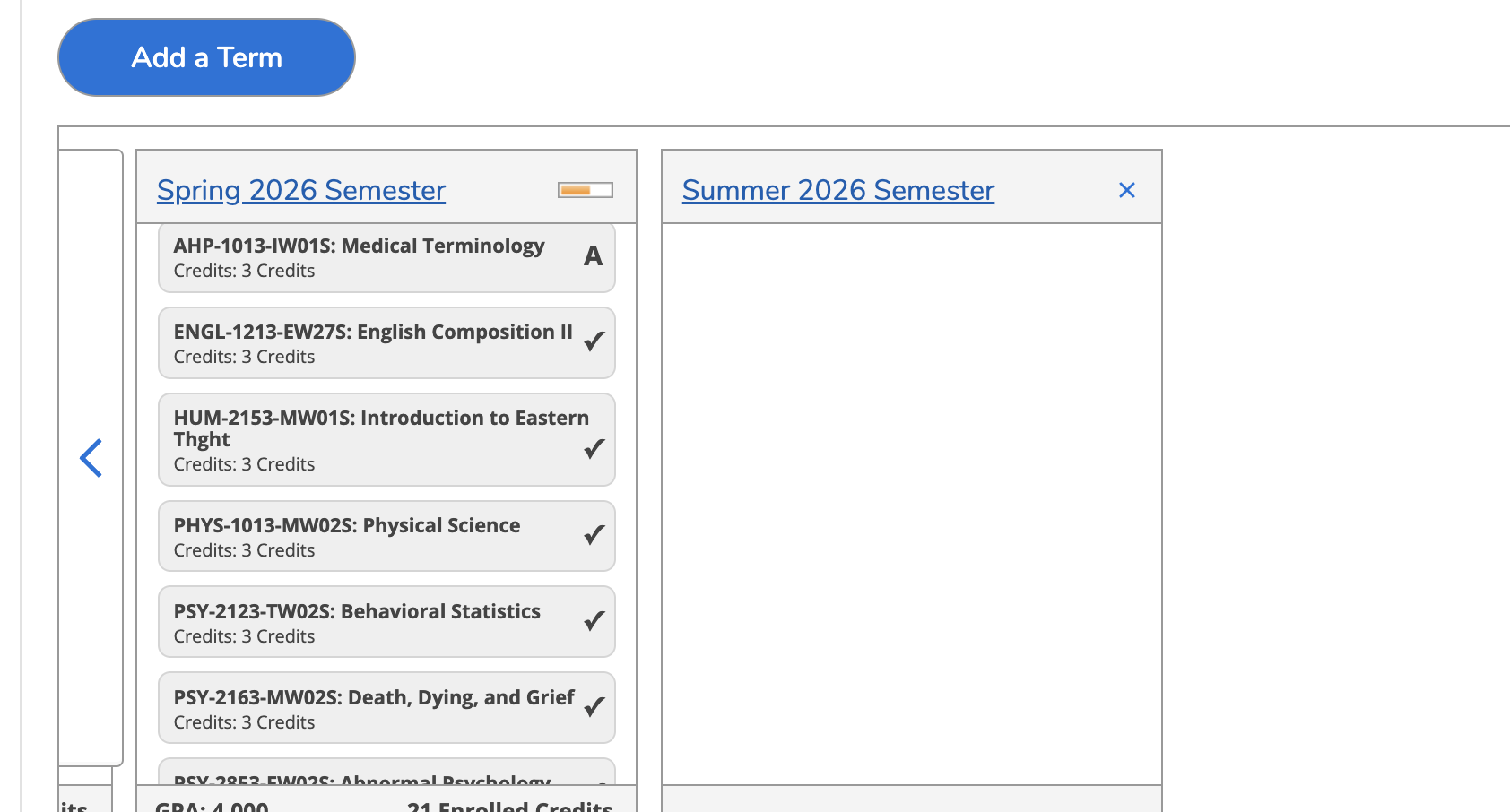
(I asked for overload credits to finish it in the spring, but don’t copy me “just because”).
I also just got back from a winter trip to Alaska, which is not as cheap as I expected

Sunset in Fairbanks
Before we start, I want to clarify a few points: we all have different backgrounds, goals, personalities, and even genetic predispositions. Just because I am capable of doing something doesn’t mean you can do it easily, and the other way around. What you can do doesn’t necessarily mean I can do it too!
Here are the main ways I use them (there are plenty of other things, but I can’t list everything because who wants to read a long scroll?).
1. Work strategically.
Strategically? it means work less and don’t push yourself too hard.
Sounds a bit off?
We are not machines, so "keep pushing" isn’t a sustainable approach in the long run.
While I do earn a lot of credits at once, I neither pick only the difficult ones nor take 6 to 7 classes at the same time.
One time, I took math and music. Other times, I tried English Composition with social issues. Even this term, I used the same strategy: I enrolled in one accelerated class that lasted only two weeks at the start of January and managed to complete it, earning 3 credit hours. Then I take one or two classes that last 16 weeks, so the workload can be spread out, and I have more time, plus one or two in the first 8 weeks of spring and another one or two in the final 8 weeks.
It took me a few months to figure out this method, but it is totally worth it. This way, I can earn 21 credits while still working 7 days a week.
We can be different; you don’t need to take as many classes as I do. I have my personal reasons for doing it this term, but not in the future. The ultimate goal is to maintain the GPA to possibly apply for scholarships, so drop it if you feel like you can’t.
I can still make it to the honor student society, so no worries on my end.
2. Know YOURSELF
We tend to know a lot about everything else in the world, or whether the ex has a new partner, but we spend too little time getting to know ourselves.
The most important thing for me when managing such a strict schedule is knowing when my body performs its best. Morning? Mid-day? Evening? Or night owl?
I am more of a morning person. I can wake up early every day, get a cup of dark Vietnamese coffee, and jump right into studying.
To you, it can be different, so figure it out.
Figure out when you're at your peak energy levels and use that time for your toughest stuff. Save that power for the subjects that give you a hard time, like math and science, where I struggle.
3. Rest, rest, and rest.
Sleep deprivation can be a game-changer in this game, the game we try to manage.
It can alter our attitudes, make us more negative and irritable, shorten our attention span, and so on. There are plenty of studies on sleep out there if you need them.
And: I can’t function like a normal human without getting a full 8-hour sleep each day. So no matter how busy I am, I will never sacrifice my sleep for anything else.
It is just not worth it.
I can save a couple of hours to work extra, but the quality of my work will never match what it was when I was fully awake.
I also realize that I am luckier than many readers here because I live in a peaceful environment without noise pollution or external danger, so I appreciate it.
4. Get ONE thing done at a time
We often try to do too many things at once when we feel overwhelmed by responsibilities, or just out of habit.
A little bit of jazz while commuting: acceptable (I won’t tell you that I like jazz!)
Some audiobooks while cleaning the house: also acceptable.
But listening to upbeat music while reading or studying IS unacceptable and so on. Why?
Our brains aren’t structured to work that way. I know some people can actually multitask very well, but that population is very FEW. We might not belong to that group, though.
Thus, our brains just switch back and forth between tasks. It can’t focus. And like a muscle without training, it gets weaker and weaker. Furthermore, we have to reread or study many times after that to ensure we get things right.
So, multitasking is not really a good way to save time, isn’t it?
If you say yes, you can skip this part and read it again.
If you read till this part, thank you, and see you next time. I’m so sleepy now.
5. If you can, go ONLINE
Go online, I mean, taking online classes instead of the traditional ones.
I know there are pros and cons for each option, so this technique might not be for everyone.
I don’t really have any friends from school. I don’t get much opportunity to really get to know any professors. The workload for online classes can be a bit heavier than traditional classes because you simply have to do a lot of writing, essays, and reflections to earn the points instead of participating in other group activities in the classroom.
I know that sounds a bit daunting, but as long as you know your priorities, your path gets clearer.
In my case, I know I don’t have any financial support from my family. I’m lucky enough to have a fairly flexible full-time job. I live like a zombie without traveling (I can travel six months, work six months if life allows). So, the most important thing, or the power source for everything I do, is traveling.
Fortunately, I can take classes and travel simultaneously, as long as I have a stable internet connection.
In addition, I can work every day while staying on top of my schoolwork.
Last but not least, I rarely use the internet for other recreational activities. I don’t even have the Facebook, Instagram, or TikTok apps on my phone to scroll through.
So, go online INTENTIONALLY.
Additional information:
Hanson, Melanie. “Average Cost of College & Tuition” EducationData.org, 2026-02-14,
https://educationdata.org/average-cost-of-college